County Employees Sharpen Disaster Recovery Skills

Few expected the training to come in handy so quickly.
With the Shockey Fire burning last week, some County employees headed into an orientation on how to help victims in the aftermath of a disaster.
Just two days later, they used those fresh lessons to open a Local Assistance Center (LAC) in the backcountry town of Jacumba. The Shockey Fire had burnt or damaged more than a dozen homes, destroyed cars and charred a total of 2,556 acres in that area. An elderly man perished after he ignored evacuation orders. A LAC at the Jacumba Library served as a one-stop-shop, helping victims to get the resources they needed.
As devastating as the incident was, County employee Jimmy Wong, who trained on Monday and managed the Jacumba LAC on Thursday, knew the fires could have been even worse. Next time, the County may need to help more victims at more LACs.
“The training was really valuable preparation,” said Wong, a Land Use & Environment Group CAO Staff Officer. “I felt much more ready to head out to the Jacumba LAC.”
The training was part of a broader effort called the Advanced Post-Disaster Recovery Initiative. Approved last year by the Board of Supervisors, it is designed to better prepare the region for natural and man-made disasters and speed up recovery efforts. Among the key pieces of the project – years in the making – is to pre-train a group of employees to staff LACs. It also calls for helping citizens recover from disasters, restoring community lifelines, such as water and power, and rebuilding communities.
All County employees are considered disaster workers. A new video will be offered at new employee orientation explaining that. In addition, over the past 10 days, about 175 County employees got specialized training on how to operate LACs.
Leslie Luke, a group program manager with the Office of Emergency Services, said he was not aware of any other local government in the country conducting this kind of recovery training.
“It will help us be able to respond in a more efficient and organized way,” said Luke. “It’s one thing to have a plan, but it’s another to have people trained to implement that plan.”
Stephen DeBlasio, a federal disaster recovery coordinator with the Federal Emergency Management Area Region IX, said staffing assistance centers like this after a disaster can pose a major challenge.
What the County “is doing is out front, it’s very aggressive,” DeBlasio said.
The roots of the initiative lie in a community meeting held in Fallbrook in late 2008, just a year or so after the devastating 2007 firestorms, Luke said. County officials and community members met and talked about what could have been done differently to better prepare and respond. From there, Luke and others got to work. By February 2011, all 18 cities in the County had approved guidelines for establishing LACs in the region. In the last few months, employees from departments across the County have been tapped and assigned their roles at LACs too. Tasks range from IT Technician and Accounting Representative to Children’s Area Worker.
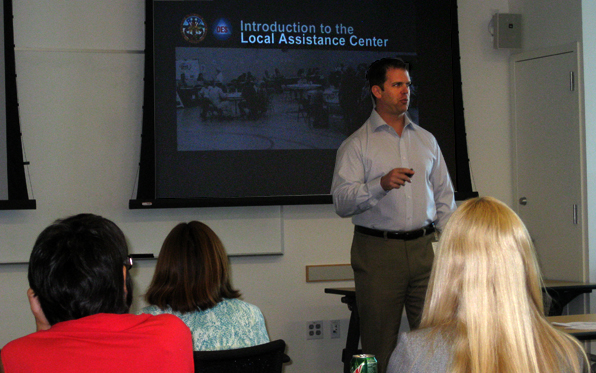
In a training session Monday, Human Resources Analyst Carl Smith told the employees assembled at the County Operations Center that they had been chosen for their range of skills and also for their leadership and character. Among them were Health and Human Services Agency employees who would oversee child care, employees from the Office of Strategy and Intergovernmental Affairs and an IT expert from the County Technology Office.
The group heard from Holly Simonette, an employee who was affected both personally and professionally by 2007 wildfires. Her husband was called to duty as a firefighter during the fires and Simonette, CAO Staff Officer in the Community Services Group, had volunteered to serve as a LAC manager in Ramona. The couple didn’t see each other for two weeks, she said, stressing the need to prepare in advance, such as coming up with a plan for who will feed the cats and do the laundry. Simonette advised the group to make sure other LAC workers were getting the help they needed at home, too.
“They’ll crash and burn otherwise,” she said. “Hopefully that won’t happen.”
Simonette also emphasized the need to be adaptable and think on your feet while working with disaster victims. This was also a conclusion drawn last week by HHSA’s Assistant Deputy Director for North Regions Jennifer Bransford-Koons, who did the LAC training and then acted as LAC manager in Jacumba.
“People who are supposed to be there may not get there when they’re supposed to,” she said of LAC workers or others. “Food may not show up or you may need more tables for food. All sorts of things (can happen) and you just have to roll with the punches.”
LACs may be set up in remote locations, she said.
“In Jacumba, you can’t just run down to Office Depot to pick something up,” she said. “You have to be flexible and creative to make things happen.”
Luke said he plans to hold a debriefing session following the Jacumba LAC and continue to train the employees before the need to set up another LAC arises.
For more information on the Advanced Recovery Initiative or to watch videos on each on the LAC roles, visit http://www.sdcounty.ca.gov/oes/emergency_management/plans/oes_jl_establish_lac.html.