Helping Keep Off-the-Grid Water Systems and the Public Safe
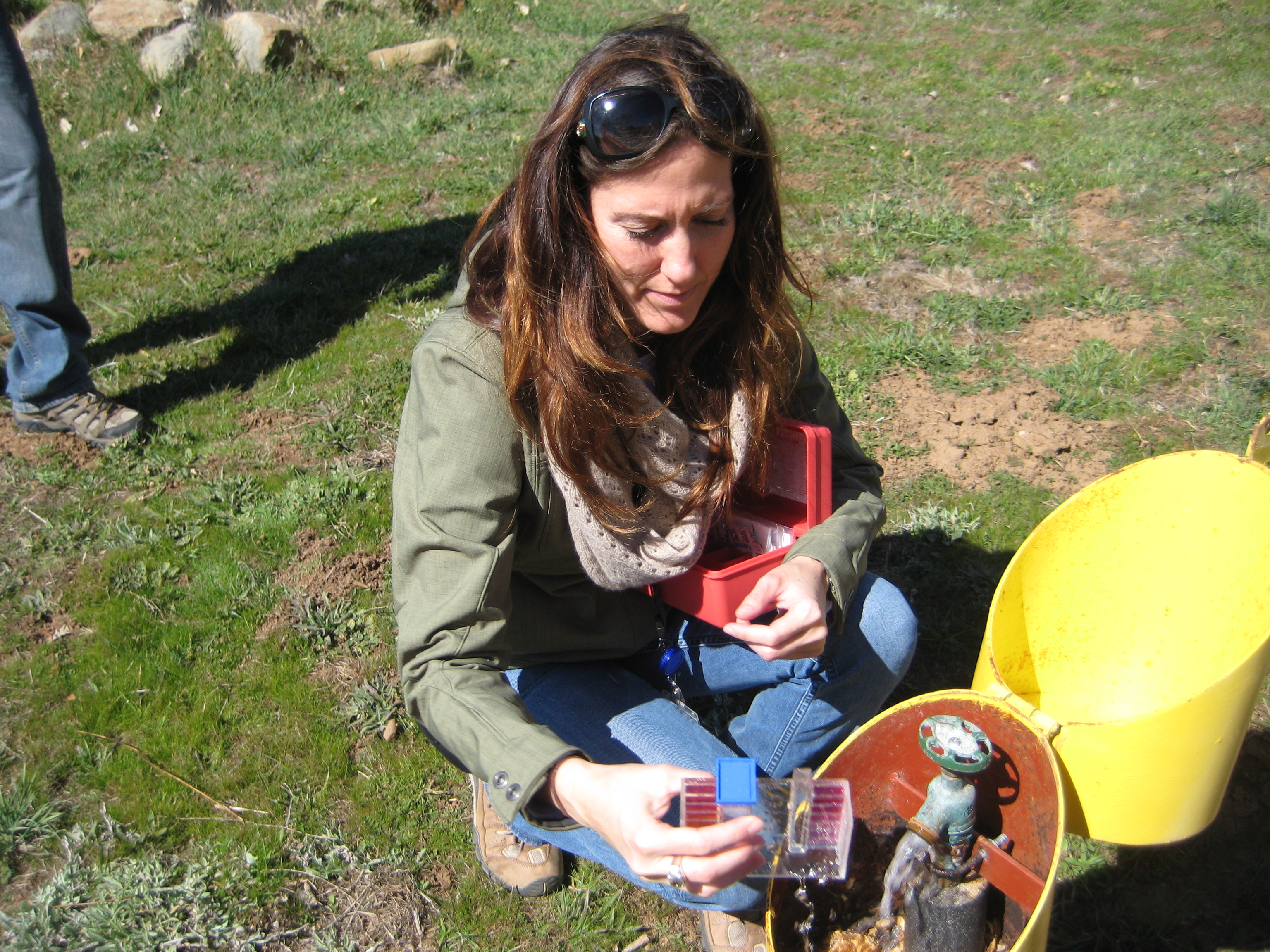

Jamelle McCullough kneels down in the mid-morning sun near Lake Cuyamaca and peers intently into the water swirling in the graduated cylinder from her water-testing kit.
She’s looking for the tell-tale shade of pink that confirms that the well-water system she’s inspecting has the right level of protective chlorine to make sure everyone who drinks it is safe.
McCullough — who has a bachelor’s of science degree in biology, a master’s degree in public health, the friendly nature of your next-door-neighbor and a cabbie’s encyclopedic grasp of county roads — is one of two County Department of Environmental Health (DEH) inspectors who monitor and regularly examine the 166 “small water systems” spread across the county.
McCullough and DEH help these systems keep residents safe in several ways. They make sure the people operating the systems know what types of water-testing they are scheduled to undergo each year. They visit and inspect their wells, storage tanks and pipeline systems to make sure they’re secure from potential contamination and complying with the federal Safe Drinking Water Act. They provide technical help and offer training to water-systems staff members. And they issue public “Boil Water” orders — which tell people not to drink the water until they’ve boiled it to make it safe — when systems occasionally get contaminated, and then work with the folks who operate the systems to correct problems and get them safely running again.
McCullough, who loves to travel in her private life and has visited exotic locations including Belize, Guatemala, Mexico and several European countries, said the inspection program is fundamental to public safety.
“I think water is kind of the basis of public health,” McCullough said. “Clean water is what differentiates, in my opinion, a developed country from a third-world country. There are very few countries in the world — that no matter where you go — when you turn on that tap, you’re pretty much guaranteed that it is safe to drink from.”
Small and Off the Grid
“Small water systems” are exactly that, water supplies that are small, serving fewer than 200 connections — homes, schools, workplaces, campgrounds, parks and properties. (Individually-owned private wells are not part of these systems.)
But they’re also water systems that are “off the grid,” so-to-speak.
Most of San Diego County’s 3-plus million residents drink, bathe and play in water that is supplied, monitored and tested by a linked chain of water agencies, starting with the massive Metropolitan Water District of Southern California, flowing to the San Diego County Water Authority, to dozens of smaller agencies scattered across the county.
But small water systems are mainly well-water systems located in rural backcountry areas outside of water agency service lines — and those larger water-agency protections.
So these systems, under the watchful eyes of DEH, use private laboratories to do the testing that ensures their water systems are safe from dozens of different types of contaminants. Those range from bacteria such as coliform and E. coli; to nitrates from animal wastes, fertilizers, polluted stormwater runoff, decaying plants and private septic systems; “volatile organic compounds” that come from gasoline and fuel-related chemicals; to metals such as chromium, copper, lead and mercury; chemicals like arsenic, even radioactive materials like uranium.
Staying Safe
On her recent trip to the Cuyamaca Water District, McCullough inspected that system’s new well — a 12-inch-across capped pipe jutting up out of the ground that was already “artesian-ing” (bubbling) up water although it hadn’t been cleared yet to be brought online — its four active wells and its two large above-ground steel storage tanks, one 210,000 gallons, the other 25,000 gallons.
As she accompanied Ron and Charley, the system operators, on a two-hour tour of the system, McCullough explained that even though wells are sealed with watertight casings after drilling to protect them from groundwater contamination, there are many ways systems can become tainted.
For example, a crack in the concrete slab around the well-head could mean that it has suffered a potential entry point for contamination. Hose bibs that allow people access to the water supply can accidentally suck up tainted water from hoses or puddles into the system if they aren’t fitted with vacuum breakers to prevent backflow. Torn vents on storage tanks can allow critters access. Rodents, McCullough said, love to chew on lines on chlorinated systems.
Graffiti on storage tanks signal that people — and possible contamination — have access to the system.
If trees or shrubs are too close to the wells or storage tanks, squirrels, rodents, lizards or other animals could urinate in or defecate in — or even fall into — the water supply. Likewise, the roots of plants that are too close to the systems can actually “invade” pipelines, storage tanks and the wells themselves.
“These plants are survivalists,” McCullough said. “Their roots are just so intrusive, and if you’ve got a tank with this unlimited supply of water in it, they’re going to find a way to get in there.”
McCullough said about a year ago, everyone was baffled by a small water system that kept testing positive for coliform. Coliform bacteria are found in the intestines of all warm-blooded animals and people, but also in plants and dirt and nature. Unlike E. coli, a specific type of fecal coliform that can make people seriously ill, most coliforms won’t make people sick. But, water testers use coliform presence as an indicator that other pathogens that could make people ill could be in the sampled water.
McCullough said after numerous tests, inspectors and system operators narrowed the source of the contamination to the tank, a submerged, cement-lined tank.
She said they eventually sent a diver into the tank to inspect it.
“What do you think we found?” she asked. “All kinds of roots! They made their way through the cement and into the tank!”
Working Together
McCullough said DEH provides a second set of eyes that can help system operators by pointing out potential problems. And she said that the system works well because she and County inspectors work well together with the people operating the systems — answering questions and providing help when needed.
“It’s really working with these guys,” she said. “We’re not just trying to regulate them, we’re trying to help. Yeah, it’s almost like ‘regulation through partnership.’”
Editor’s Note: Click here for more information about the County Department of Environmetnal Health’s small water system program.