Medical Examiner Chaplain Honored by Organ Donor Organization
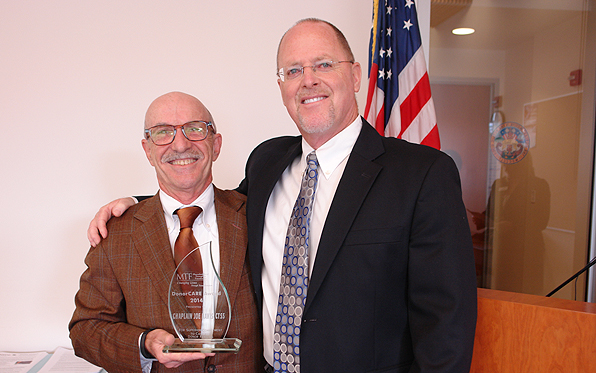

Chaplain Joe Davis reaches out to San Diego families whose loved one has died, often unexpectedly. In many cases, the discussion involves the person’s decision in life to donate his or her organs or tissue upon death.
Davis was honored Friday for his compassionate work with grieving families by Board of Supervisors Chairwoman Dianne Jacob and Lifesharing, a nonprofit, federally-designated tissue and organ recovery organization. He has volunteered as a full-time chaplain for the San Diego County Medical Examiner’s Office since 2000, establishing and running a Bereavement Center for families of medical examiner cases.
“Joe Davis knows organ, tissue and eye donation benefits not only the recipients, but also the grieving families who may find some solace in the knowledge that their loved one was able to help heal or even save the lives of one or more people,” said Jacob in a proclamation for Davis.
Jacob recognized Davis for being recently selected as a recipient of the prestigious 2014 DonorCARE Award by the Musculoskeletal Transplant Foundation. Lifesharing submitted Davis’ name for the national award earlier this year and the foundation’s judges unanimously chose him. The award is presented every other year and commends those who have demonstrated a commitment to donor families above and beyond what is currently recognized as the industry standard of care.
“He just has sensitivity and compassion and a sense of humor,” said Sharon Ross, Director of Community Outreach for Lifesharing. “He will follow up with families up to two years later to see how they are doing.”
Lifesharing Executive Director Lisa Stocks shared a story from a donor family Davis worked with. Davis called a mother whose daughter died every day for some time. The mother later wrote about his counseling that, “I think I would have survived without it, but I really don’t know how. What he did, there’s no price tag for it.”
The County Medical Examiner’s Office works with Lifesharing to give them access to the loved ones who are donating tissue or organs for transplant or research.
RELATED: Lifesharing Program Saves Lives
“A lot of the Lifesharing and donor families are our families too,” said Davis. “It’s a matter of ‘what can we do to help the people we serve?’”
Davis also volunteers as a family liaison for San Diego Eye Bank, the UC Irvine Brain Research Program and Lifesharing. But while Davis believes organ and tissue donors are giving others life and hope, as a representative of the Medical Examiner’s Office, he never tries to persuade anyone to donate their loved one’s organs or tissue, unless it had been the deceased person’s wish. His focus is on helping explain what the program does and who it helps.
Typically, a representative from Lifesharing or the Eye Bank approaches grieving families to ask them to consider donation, if the person did not indicate his or her wishes before their death. Davis’ job comes after that has already been decided. Many of the organ and tissue donor families are ones he would normally reach out to anyway through his counseling role with the Medical Examiner’s Office. Even in these cases, he can help answer any questions and offer comfort where families might have questions or apprehension about organ and tissue donation.
Davis is modest about being selected for the award, saying that the award really is highlighting the San Diego Bereavement Center.
RELATED: A Comfort for Grieving Families
As the award winner, Davis was also asked to conduct a webinar for other coroner or medical examiner offices who want to replicate his success with the Bereavement Center program. The Bereavement Center is one of only four in the nation and the only one in California. And none of the other similar programs are run by a volunteer.
The center’s services include creating and offering a resource book in English and Spanish at no cost to the County for grieving families. The book walks people through the day-to-day details that must be attended to such as selecting a mortuary or crematorium for their loved one. It also includes a list of free grief counselors.
Not all Davis’ work is with grieving families. Ross also lauded the preventative work Davis does trying to steer people on dangerous paths back on track for recovery.
“He does so much in terms of support for families and making sure they would never have the need for the medical examiner or Lifesharing,” she said.
Davis designed a program called, “Beyond the Caution Tape,” which is tailored toward adults on probation and leading risky lifestyles due to drug or alcohol use or impulsive behavior. The program very frankly illustrates with real photographs where risky lifestyles can lead: the Medical Examiner’s Office. He teaches a modified version to juveniles as well. Davis said the program makes a big impact on the participants especially as they are asked to imagine how their family members would react to the news of their death.
“He has turned lives around,” Ross said.