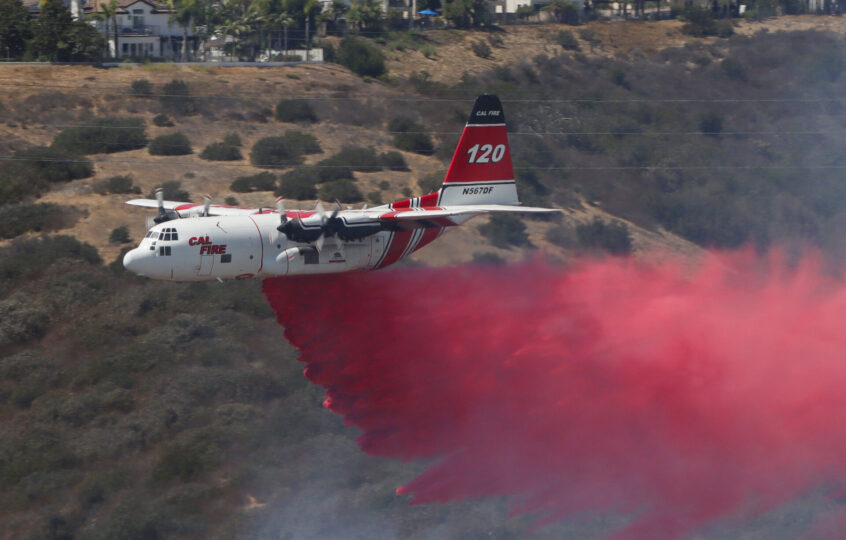
San Diego County fire, emergency and law enforcement leaders outlined sweeping investments and coordinated plans to confront a high-risk wildfire season, citing critically dry fuels, Santa Ana winds and rapid regional growth as the chief concerns. Officials said the county has expanded staffing, modernized equipment and strengthened cross-agency coordination to protect communities across one of California’s most active wildfire regions.
A Changing Threat, A Unified Response
Chief Tony Mecham of County Fire and CAL FIRE traced the region’s modern wildfire strategy to the devastating 2003 and 2007 firestorms, which burned more than 750,000 acres and exposed gaps in preparedness. In 2008, the Board consolidated rural departments into San Diego County Fire, forming a unified service designed to plan, coordinate and invest at regional scale. “The greatest concern remains the alignment of critically dry fuels with the onset of Santa Ana wind events, when the potential for large, fast-moving wildfires will be at its highest,” Mecham said.
Residents are protected by an increased CAL FIRE of more than one thousand firefighters in more than 40 fire stations, fire camps and aviation facilities. Arial firefighting has expanded with the County’s Firehawk helicopter, capable of 1,000‑gallon drops and nighttime response, and a CAL FIRE C‑130 Hercules based at Ramona, following upgrades that cement Ramona’s role as a Southern California aviation hub.
Mecham emphasized the county’s growing use of technology, Tablet Command for real‑time unit tracking and tactical sharing, digital mapping of perimeters and evacuations, and the new AWARE California platform, which integrates UCSD wildfire cameras, satellite detections and weather feeds. “For residents, the public‑facing application provides access to live camera imagery and incident information, allowing them to monitor conditions across the region and better understand wildfire activity,” he said.
Reducing Risk Before the Flames
Mecham also highlighted pre‑fire investments: the Vibrant Planet platform, to help identify potential fuel reduction project areas, validate existing projects, and support Community Wildfire Protection Plan development and Unit Fire Plan. County Fire uses Community Risk Reduction work to clear more than 800 lane miles of vegetation in 2025, create more than 200 acres of fuel breaks, and treat 45 lane miles of roadside vegetation with retardant. Crews also have completed more than 37 thousand defensible‑space inspections, updated 10 Community Wildfire Protection Plans and supported 17 new Fire Safe Councils. Fire crews and partners also train dozens of Community Emergency Response Teams (CERT), who volunteer to support our communities.
OES: Coordination Before, During and After
Daryl Arbuthnott, Director of the County Office of Emergency Services, said OES ties together county departments, cities, tribal governments, special districts, utilities and state and federal partners so the region responds and recovers as one coordinated system. “Simply put, our role is to ensure the entire region works together before, during, and after disasters,” Arbuthnott said.
OES recently reorganized around the emergency management lifecycle, creating dedicated divisions for Community Engagement and Preparedness, Planning and Training, and Response and Coordination. Each Division will have a Recovery Coordinator assigned to it. Over the past year, OES conducted 70‑plus community outreach events—including a regional Fire Weather Workshop—updated the Multi‑Jurisdictional Hazard Mitigation Plan with new wildfire actions, revised the County Emergency Operations Plan (including the wildfire annex), strengthened training and exercises, and enhanced the AlertSanDiego.org website and mobile app, and Genasys Protect for public warnings and evacuations.
Sheriff’s Office: Evacuations and Public Warning
Sergeant Michael Hanks said the Sheriff’s Office manages mutual‑aid planning and logistics for disasters, participates on the County’s Evacuation Committee and joined the statewide AwareCA portal working group in June 2026 to improve real‑time alerts. The office partners on the Ag Pass program for farmers and ranchers and this year launched the Emergency Tribal Access Pass (ETAP) for qualifying tribal government members and employees to support zone stabilization efforts.
“During a wildfire, law enforcement’s role in Unified Command focuses on evacuating impacted communities, protecting rights of way, and safeguarding property,” Hanks said. “The decision to issue evacuation orders is not made lightly. It will depend entirely upon the nature, scope, and severity of the emergency, the number of people affected, and what actions are necessary to protect the public.” He added that deputies notify the public via multiple systems, including Wireless Emergency Alerts, Genasys Protect notifications, AlertSanDiego.org notifications, Hi‑Lo audible warnings, and even deputies going door to door to reach people with emergency messaging.
ASTREA: Eyes in the Sky
Lieutenant Gavin Lanning described ASTREA, the Sheriff’s aerial support unit, as central to firefighting, patrol and search‑and‑rescue operations. In 2025, ASTREA responded to more than 5,500 missions, including 285 fire dispatches and 985 water drops. “Protecting San Diego County from the threat of wildfires requires a true team effort, it is a mission far bigger than any one agency,” Lanning said, citing co‑location with County Fire and CAL FIRE and joint training that enables seamless emergency response.
ASTREA currently fields one modern Bell 412 EPX and two aging Bell 205s. The Sheriff’s Office is pursuing funding for a second Bell 412 EPX to ensure year‑round coverage with a safer, more capable twin‑engine aircraft and to extend shift coverage into hours of darkness, bolstering nighttime suppression and early containment.
Looking Ahead
Officials said the county has invested more than a billion dollars in fire protection and preparedness over two decades, reshaping the region’s fire‑response system. Future priorities include modern fire stations, fleet replenishment, staffing, regional training, brush management, and a second twin‑engine 412 helicopter to sustain year‑round coverage.