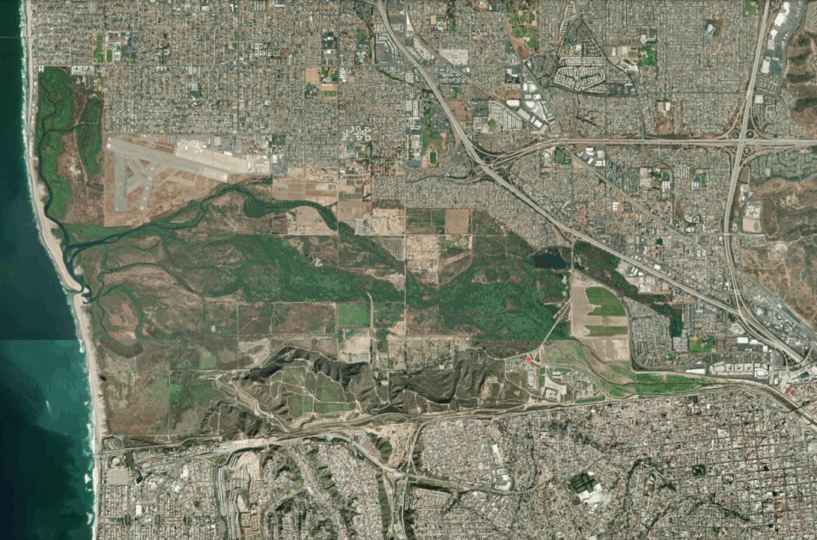
People in the South Bay this past weekend, especially those living near the Tijuana River Valley (TJRV), experienced high hydrogen sulfide (H2S) emissions, often recognized by a strong rotten egg smell.
San Diego Air Pollution Control District monitors reported the average hydrogen sulfide emissions in the Tijuana River Valley in the four-hour period between 9 p.m. Sunday and 1 a.m. Monday was 384 parts per billion (ppb), which exceeded the Level 1 Federal Acute Exposure Guideline Level (AEGL) threshold of 360 ppb. The levels were recorded at the Nestor monitor atop Berry Elementary School which is closest to where Saturn Boulevard crosses the river and a drop in elevation creates a small waterfall that can cause the wastewater to foam which in turn can boost emissions.
By 10 a.m. emissions at the Nestor monitor dropped to 5 ppb, below the San Diego Air Pollution Control District (SDAPCD) 30 ppb H2S advisory threshold. The H2S emissions are being tracked by the SDAPCD’s network of monitors. The public can sign up to receive email and/or text alerts when emissions surpass 30 parts per billion. Current emission levels and other Tijuana River Valley pollution data are also tracked on the County’s Tijuana River Valley dashboard.
The County continues to work together with SDAPCD and other partners to monitor conditions and update the public the affected South Bay communities.
The U.S. Environmental Protection Agency defines exceeding the AEGL Level 1 as an event that will cause “notable discomfort, irritation, or certain asymptomatic non-sensory effects. However, the effects are not disabling and are transient and reversible upon cessation of exposure.” AEGL Level 2 for the four-hour exposure is more than 55 times higher than these recent elevated levels.
“These ongoing emission exposures to people living in the South Bay are unacceptable,” said Dr. Sayone Thihalolipavan, M.D., M.P.H., County Public Health Officer. “While the County of San Diego and others continue to urge the federal governments on both sides of the border to treat these flows and get them out of the river, there are actions people exposed can take. These include the use of the right indoor filters, such as those the Air Pollution District distributes, and keeping doors and windows shut during the most intense periods. Individuals experiencing a health issue should seek care by their medical provider or if it feels life threating go to local hospital emergency department.”
Additional recommendations are included in the Community Hydrogen Sulfide Guidance for when levels exceed 30 ppb.
It is unclear why the emission levels rose. The US International Boundary and Water Commission (USIBWC) dashboard reports river levels running at or below recent daily levels. The USIBWC reports that this week is expected to resume operations at the PBCILA pumping plant with the goal of reducing cross-border flows through the Tijuana River.
The USIBWC regularly reports it is in continuous contact with construction and project managers in Mexico and has been working extensively with Mexico to mitigate transboundary flows as much as possible.
A collaborative partnership that includes the USIBWC, U.S. Environmental Protection Agency (EPA), California Department of Public Health (CDPH), San Diego Regional Water Quality Control Board (SDRWQCB), San Diego County Air Pollution Control District (SDAPCD), and the County of San Diego has been working together since 2024 on the sewage treatment issues, progress updates and health concern guidelines.
The County also continues to coordinate with the Tijuana River Coalition, healthcare providers and community organizations to support affected residents.
“We are committed to supporting the South Bay community,” said Dr. Sayone Thihalolipavan, M.D., M.P.H., County Public Health Officer. “We will continue to coordinate to expand resources and find long-term solutions to the unacceptable conditions in the Tijuana River Valley.”
How People Affected Can Reduce Exposure
People in affected communities can take steps to reduce the impact of the hydrogen sulfide (H2S) by:
- Limiting their outdoor activities if odors are bothersome.
- Keeping doors and windows closed when odors are present and air out your home or building when odors improve.
- Increasing air circulation indoors using fans or air conditioning on recirculation mode.
- Running an air purifier with a high efficiency particulate air (HEPA) filter, activated charcoal and potassium permanganate, is particularly effective for H2S odors.
- Signing up to receive a free, high-quality air purifier from SDAPCD.
- Those purchasing their own air purifiers can find a verified model with potassium permanganate on the California Air Resources Board (CARB) website and also get more information on a dedicated Tijuana River Valley website created by CARB.
- People who are more sensitive to air pollution like those with asthma, chronic obstructive pulmonary disease (COPD), or other chronic lung conditions should keep rescue medication(s) readily available. Anyone with persistent, worrisome, or worsening, symptoms should reach out to their medical care provider or seek emergency care if symptoms feel life-threatening.
More information about the ongoing pollution in the Tijuana River Valley and South County beach water is available from the SDAPCD, IBWC and the County’s dedicated Tijuana River Valley & Beach Water Sewage Crisis webpage.