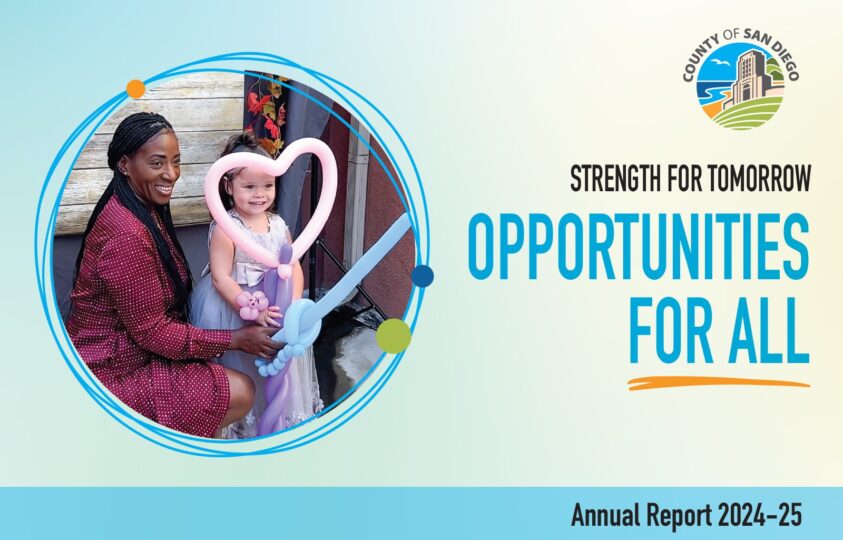
The County released its Annual Report Wednesday, highlighting its work with the community and other local government agencies and organizations toward a vision of a just, sustainable and resilient future for all.
The theme of the online 2024-25 Annual Report is “Opportunities for All; Strength for Tomorrow.” It shares accomplishments in the key areas of behavioral health; environmental sustainability; equity; healthy and safe communities; homelessness and affordable housing; and public safety and justice reform.
A few of those accomplishments include:
- Working with the Centers for Disease Control and Prevention to conduct two South County health surveys — the Community Assessment for Public Health Emergency Response and the Assessment of Chemical Exposures — to help look for solutions to the Tijuana River Border Sewage Crisis.
- Opening the new state-of-the-art San Diego County Public Health Laboratory, expanding capacity to test for infectious diseases, food and water safety and dangerous pathogens.
- Addressing homelessness and affordable housing by helping complete seven affordable housing developments with another 15 projects underway.
- New behavioral health resources, including construction of the County’s first East County Crisis Stabilization Unit to help people experiencing mental health crises; opening a one-stop resource center in Ramona; and creating new beds for substance use treatment and recuperative care.
The County’s Annual Report provides a snapshot of work done during the fiscal year, which stretches from July 1 to June 30. It also gives a glimpse into the County’s priorities and goals.
The County, with an $8.63 billion budget, provides services and programs that touch the lives of nearly all county residents.
In the unincorporated areas, County government is responsible for the day-to-day things a city government would do, from law enforcement and fire protection to roads, libraries and parks. It also provides services that support the entire county, things like social services assistance, safety net and health programs, food and restaurant inspections, elections, foster care and more.
Some other Highlights from the Annual Report include:
Behavioral Health
- In January the County’s rapidly growing Mobile Crisis Response Team Program marked four years of helping people who face behavioral health crises. The teams send trained behavioral health experts rather than law enforcement, when appropriate, into non-violent situations to de-escalate and help people who are experiencing a mental health crisis.
The program answered 131 calls in its first year. As of August 2025, it has answered more than 24,000.
Environmental Sustainability
- The County adopted a new Climate Action Plan, its blueprint for reducing greenhouse gas emissions in the unincorporated areas and at County facilities, with the goal of reaching net-zero emissions by 2045. The plan includes 70 actions designed to reduce greenhouse gas emissions.
- The County’s Parks and Recreation Department and its community partners planted 4,657 trees to naturally remove carbon dioxide from the air and lower temperatures. Some of those trees were planted in communities deemed by the California Healthy Places Index to be in need of increased shade from healthy trees.
Equity
- The County continued its Equity Impact Grants program, naming 10 local, small nonprofit organizations to win the County’s second batch of $100,000 grants and a year’s worth of custom coaching to help them further their missions and advance equity and belonging throughout the region.
Healthy and Safe Communities
- The County and community members broke ground on a project to revitalize the Mira Mesa Epicentre as a County-operated community center and recreation center for teens. Designed with community input, the new center will include a multifunctional pickleball and basketball court, community garden, open lawn area, rentable community space, music room, game room, practice kitchen, and flexible study and work areas. The project will make the area safer and promote health and well-being through programs that will include mentoring, career counseling, performing and visual art, gardening, cooking and recreational classes.
- The County also broke ground on the new Casa de Oro Library that will double the size of the existing library to meet the needs of the growing Spring Valley community.
Homelessness and Affordable Housing
- The County worked with cities, developers and communities to help open new affordable housing in Carlsbad, Clairemont, the College Area, Encanto, Ocean Beach, San Marcos and Vista. Those projects will help people experiencing homelessness, people with low incomes, seniors, veterans and others.
- The County continued to use surplus County property to create affordable housing.
- The County made $11.5 million available to local developers to create affordable housing to help people with low incomes and veterans experiencing homelessness.
Public Safety and Justice Reform
- San Diego County Fire and County Emergency Medical Services started a new paid-training program in July 2025 for 18-to-26-year-olds affected by the juvenile justice or child welfare programs. The program gives young people who have faced challenges in life a path toward possible careers at paramedics or emergency medical technicians. Those who are selected are paid a monthly stipend to take part in a five-month, hands-on training program. The program combines classroom instruction, hands-on skills training and regular ride-alongs with local ambulance providers.
- The County District Attorney’s Victim Assistance Program served more than 15,000 people.
- The County’s Alternatives to Detention Program continued, with 96% of young people completing the program without any new sustained law violations.