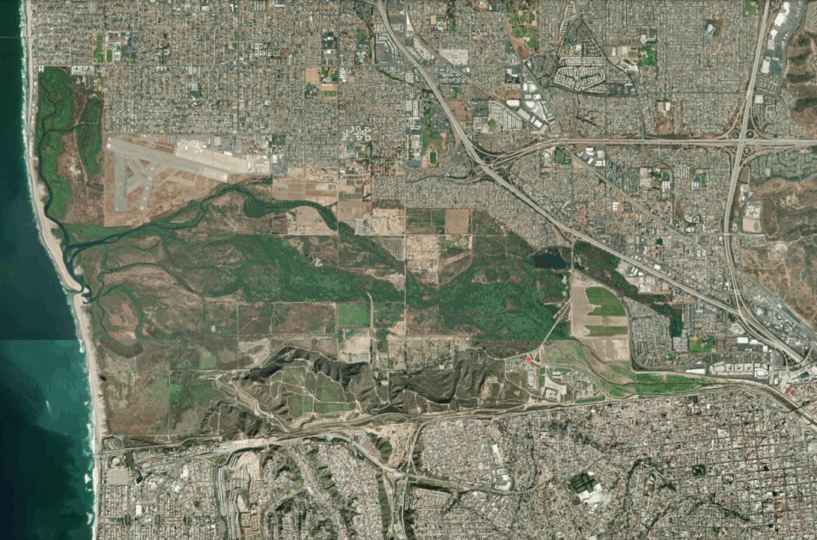
People in the South Bay, especially those living near the Tijuana River Valley (TJRV), are experiencing elevated hydrogen sulfide (H2S) emissions, often recognized by a strong rotten egg smell.
The rise in emissions is tied to ongoing untreated wastewater flows from Mexico, combined with this week’s heat wave. Forecasters expect temperatures will ease over the weekend but will remain above normal. While odor reports tend to rise regionwide during heat events, the Tijuana River Valley is unique when it experiences dry-weather flows of untreated wastewater.
The US International Boundary and Water Commission (USIBWC) reported that a pump failure at Mexican Pump Station PB1 caused transboundary flows at Stewart’s Drain on March 14 and 15 but reports it did not reach the river. The agency does not believe these flows led to noticeable emissions.
The H2S emissions are being tracked by the San Diego Air Pollution Control District’s network of monitors. The public can sign up with the District to receive email and/or text alerts when emissions surpass 30 parts per billion. Current emission levels and other Tijuana River Valley pollution data are also tracked on the County’s Tijuana River Valley dashboard.
The USIBWC regularly reports it is in continuous contact with construction and project managers in Mexico and has been working extensively with Mexico to mitigate transboundary flows as much as possible.
A collaborative partnership that includes the USIBWC, U.S. Environmental Protection Agency (EPA), California Department of Public Health (CDPH), San Diego Regional Water Quality Control Board (SDRWQCB), San Diego County Air Pollution Control District (SDAPCD), and the County of San Diego has been working together since 2024 on the sewage treatment issues, progress updates and health concerns.
The County also continues to coordinate with the Tijuana River Coalition, healthcare providers and community organizations to support affected residents.
“We are committed to supporting the South Bay community,” said Dr. Sayone Thihalolipavan, M.D., M.P.H., County Public Health Officer. “We will continue to coordinate to expand resources and find long-term solutions to the unacceptable conditions in the Tijuana River Valley.”
How People Affected Can Reduce Exposure
People in affected communities can take steps to reduce the impact of the hydrogen sulfide (H2S) by:
- Limiting their outdoor activities if odors are bothersome.
- Keeping doors and windows closed when odors are present and air out your home or building when odors improve.
- Increasing air circulation indoors using fans or air conditioning on recirculation mode.
- Running an air purifier with a high efficiency particulate air (HEPA) filter, activated charcoal and potassium permanganate, is particularly effective for H2S odors.
- Signing up to receive a free, high-quality air purifier from SDAPCD.
- Those purchasing their own air purifiers can find a verified model with potassium permanganate on the California Air Resources Board (CARB) website and also get more information on a dedicated Tijuana River Valley website created by CARB.
- People who are more sensitive to air pollution like those with asthma, chronic obstructive pulmonary disease (COPD), or other chronic lung conditions should keep rescue medication(s) readily available. Anyone with persistent, worrisome, or worsening, symptoms should reach out to their medical care provider or seek emergency care if symptoms feel life-threatening.
More information about the ongoing pollution in the Tijuana River Valley and South County beach water is available from the SDAPCD, IBWC and the County’s dedicated Tijuana River Valley & Beach Water Sewage Crisis webpage.