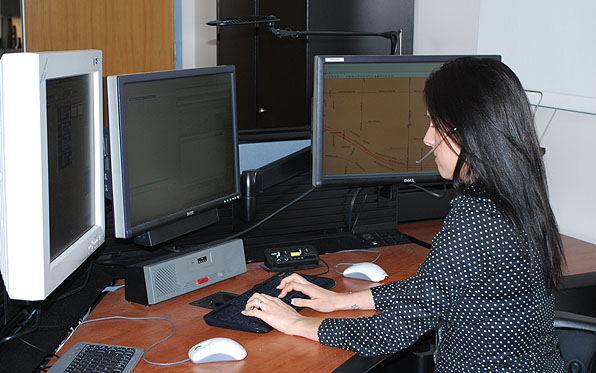
San Diego County Sheriff’s emergency dispatchers took more than 300,000 calls to 911 last year. Callers are often in or witnessing a crisis, so their adrenaline may be pumping and their nerves frayed. As part of National Public Safety Telecommunicators Week, Sheriff’s dispatchers talked about how you can help them help you if you need to call 911.
1. Location, location, location.
In an emergency, it’s the number one thing dispatchers say you need to be ready to give them.
People sometimes assume that your location pops up on a map as soon as an emergency dispatcher answers the phone. Not necessarily true. If you’re calling on a mobile phone, they do not have the exact spot. Newer model mobile phones may give them general location information but not exact addresses. Older phone models would not have that information at all. An exact address is best, or a street and nearby cross street. If you don’t know those, try to provide landmarks to help dispatchers send help.
2. Stay calm.
The dispatcher has to be able to understand you to help you.
3. When it comes to information about the call, it’s usually, who, what, where, when and sometimes why.
Deputies don’t want to respond blindly to a call that might become violent. Often, dispatchers will ask if any weapons, drugs or alcohol are involved for officer safety information. Listen to the dispatcher and let them lead you through questions.
Rather than just ask you open-ended questions, they may give you multiple choice answers. Those are often easier to process for people who are upset.
People sometimes get frustrated with dispatchers because they think that in answering many questions, it is delaying a critical response. The dispatcher is not the one responding to the scene. In a public safety call, the deputy has already been dispatched and the information being gathered is being relayed simultaneously to the deputy heading to the scene of the call.
4. Along with 911 calls, dispatchers also answer calls on the non-emergency line for situations like reporting a suspicious vehicle, noise disturbances, abandoned vehicles, illegal parking, etc.
The number to call for those kind of calls are (858) 565-5200. The non-emergency dispatch line is answered 24/7 just like the emergency line except that emergency calls are given priority, so callers could experience a short wait time.